Louvered Pergola vs Solid Roof: Which Wins for Your Patio?
Last Updated: November 7, 2026
Quick Summary
A louvered pergola gives you adjustable slats for shade and airflow control, while a solid roof delivers fixed, uninterrupted cover and full overhead rain protection. Published cost comparisons put louvered coverage at $90 per square foot versus $125 per square foot for a solid roof, before installation. Neither wins outright: choose louvers for flexibility, solid for set-and-forget weather cover.
- Fixed-roof pergolas cost 30% to 50% less than motorized louvered systems, per Cabstone.
- Closed louvers rely on slat pitch plus hidden perimeter gutters and post downspouts to shed water.
- Most louvered roof leaks start at slat-to-frame seams, gutter joints, and post or wall attachments.
- Louvered roofs vent hot air upward when open; solid roofs trap warmth unless ventilated.
- Call your local building department before ordering, since attached and larger freestanding pergolas often need permits.
Table of Contents
- Louvered vs Solid Roof Pergolas: The Core Trade-Off
- Louvered Pergola Rain Protection: What Happens When the Sky Opens
- Solid Roof Pergola Benefits: Uninterrupted Shade and Weatherproof Cover
- Louvered Pergola Cost vs Solid Roof: Upfront Price and Long-Term Value
- Best Type of Roof for a Pergola: Matching the Structure to Your Climate and Use
- Installation, Permits, and Structural Considerations for Each Roof Style
- Choosing Your Pergola Roof at Backyard Sanctuary Supply
- Frequently Asked Questions
Louvered vs Solid Roof Pergolas: The Core Trade-Off
The choice between a louvered pergola and a solid roof comes down to one question: do you want control over the sky above you, or do you want it simply blocked out? A louvered pergola uses adjustable slats that tilt open and closed, while a solid roof pergola fixes a hard cover in place.

Published cost comparisons from Moda Outdoor Living's 2026 pergola cost breakdown put lattice-style louvered coverage at $90 per square foot against $125 per square foot for a fully covered solid roof, before installation is factored in. That gap matters, but it is not the whole story.
How Each Roof Handles Sun, Shade, and Airflow
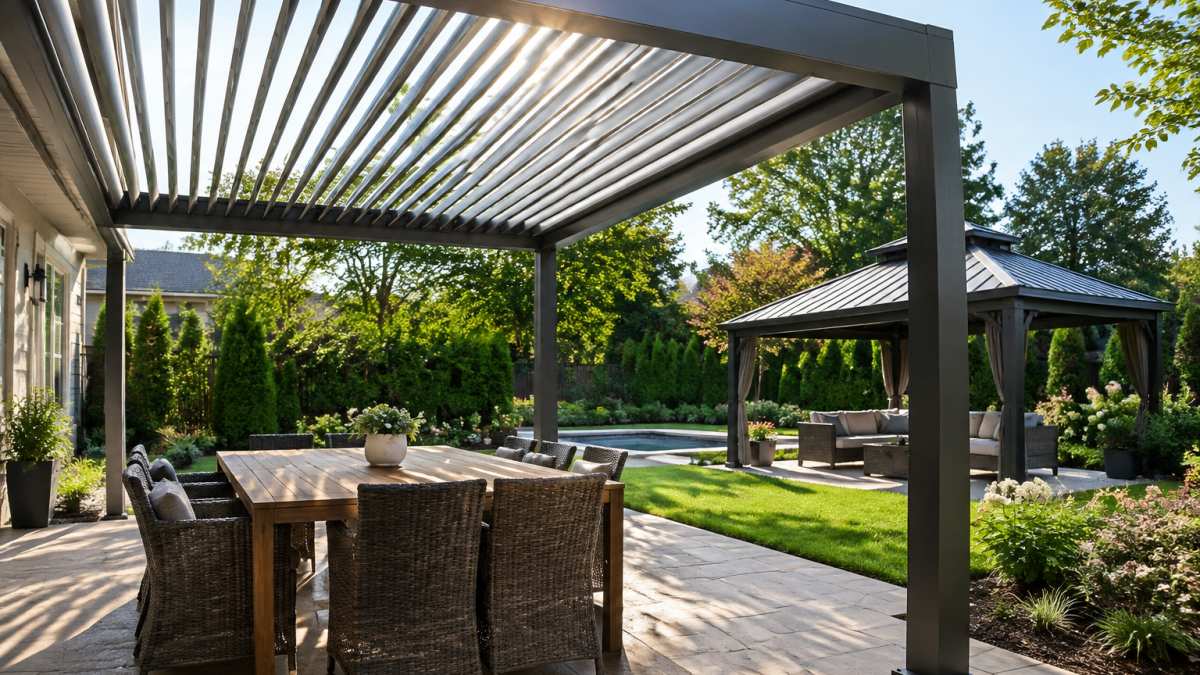
Louvered roofs win on flexibility. Adjustable louvers tilt from fully open to fully closed, so you can chase partial shade in the afternoon and open the slats for ventilation when the air goes still.
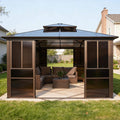
Airflow is the trade-off. A solid roof traps warmth underneath unless it includes a ventilated design, like the double-roof construction on the Alora hardtop gazebo pergola, which encourages natural airflow and reduces heat buildup.

Side-by-Side Comparison at a Glance
| Feature | Louvered Roof | Solid Roof |
|---|---|---|
| Shade control | Adjustable, partial to full | Fixed, uninterrupted |
| Airflow | Strong when open | Limited unless ventilated |
| Rain protection | Good when closed, with drainage | Full overhead cover |
| Upfront cost | Higher for motorized systems | Lower |
| Maintenance | Occasional louver cleaning | Roof and gutter checks |
| Best for | Flexible entertaining | All-weather dining |
Louvered Pergola Rain Protection: What Happens When the Sky Opens
Louvered pergola rain protection depends entirely on the drainage design, not the slats alone. When louvers close, water has to go somewhere, and cheap systems let it pool or drip at the edges. Well-built systems channel runoff through hidden gutters inside the frame and down through the posts.
How Closed Louvers Actually Shed Water
A louvered roof is not a flat lid. Each slat tilts to a fixed pitch when closed, and the slats overlap so water runs from one blade to the next rather than falling straight through.
That is why the frame, not the slats, is the real waterproofing component. The slats redirect water; the gutters and posts remove it. A louvered roof with excellent slats and undersized gutters will still overflow in a downpour.
Where the Water Goes
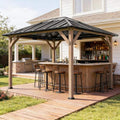
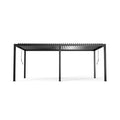
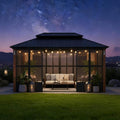
On a well-designed system, runoff follows a predictable path: slats to perimeter gutter, gutter to internal downspouts inside the posts, posts to the ground or to a drainage bed. The Alora louvered pergola with LED lights uses a hidden gutter system that moves rainwater through the posts in four directions once the louvers are fully closed, keeping the space beneath dry during a passing shower.

Ask where the posts discharge before you buy. Some systems dump water at the base of the post with no shoe or splash block, which erodes mulch and stains patios over time. A simple splash block or a gravel drainage bed at each post solves it, but only if you plan for it.
Seams, Gutters, and Installation: Where Leaks Actually Start
Most louvered roof leaks trace to three places, and none of them is the middle of a slat:
- Slat-to-frame seams. The joint where the louver bank meets the perimeter frame is a common leak point if gaskets or end caps are missing or misaligned.
- Gutter joints and corners. Gutter sections that meet at corners rely on sealant and overlap; a rushed install leaves a pinhole that shows up only in heavy rain.
- Post penetrations and wall attachments. On attached pergolas, the ledger connection to the house is a frequent entry point for wind-driven rain and needs flashing, not just sealant.
Installation quality drives water performance more than the product spec sheet. A perfectly rated system installed with skipped gaskets will leak; a mid-grade system installed carefully will stay dry in ordinary storms.
Watch out: louvered roofs are not waterproof in every position. Angled slats shed most water but can let wind-driven rain through, so treat them as shower protection rather than storm shelter.
What Louvers Cannot Do
Be honest about the limits. A closed louvered roof handles ordinary rain well, but it is not a sealed membrane roof. It will not match a solid roof with continuous panels and overlapped seams in a wind-driven downpour, and it should not be expected to. If your region regularly sees sideways rain or you want the patio usable during storms, a solid roof with proven drainage is the more reliable choice.
Solid Roof Pergola Benefits: Uninterrupted Shade and Weatherproof Cover
Solid roof pergola benefits start with certainty. There is no adjusting, no guessing, and no checking the forecast before you set the table.
Material choice drives performance. Galvanized steel hardtops resist corrosion and handle snow loads, while polycarbonate panels filter harsh sunlight without darkening the space underneath. The Alora double-layer steel hardtop pergola pairs a sloped roof for efficient drainage with a rust-resistant aluminum frame, and it supports snow loads in colder climates.
Louvered Pergola Cost vs Solid Roof: Upfront Price and Long-Term Value
Louvered pergola cost runs higher upfront, particularly for motorized systems. Cabstone reports that fixed-roof pergolas cost 30% to 50% less than motorized louvered systems, which is a real gap for budget-conscious buyers.
But upfront price is the least interesting number in this comparison. The more useful question is what each roof costs to own over ten or fifteen years, because the two styles spend their money in different places.
Purchase and Installation
Purchase price is only part of the first-year cost. Installation adds labor, and the two styles add it differently:
- Louvered systems carry more moving parts, so assembly and alignment take longer. Motorized units add low-voltage wiring, a transformer, and often a remote or wall switch, which means an electrician if you are not comfortable running the circuit yourself.
- Solid roofs are mechanically simpler but heavier. The structure has to carry the panels, so anchoring, footings, and attachment to the house are more demanding. On attached installations, the ledger and flashing work is a real line item.
A common pattern is that the installed gap between a manual louvered roof and a comparable solid roof is narrower than the product-price gap suggests, because the solid roof's structural and attachment costs are higher than buyers expect.
Energy and Comfort Costs
Neither roof is a heating and cooling system, but both affect how the space beneath feels and how hard nearby equipment works. An open louvered roof vents hot air upward, which can reduce heat buildup on still summer days. A solid roof blocks sun but traps warmth underneath unless it is ventilated; double-roof construction, like the Alora hardtop gazebo pergola, encourages airflow and reduces heat buildup.
Maintenance and Repair Over Time
This is where the lifecycle math gets interesting, and where the two styles diverge most.
- Louvered roofs need occasional louver cleaning and, on motorized units, eventual motor, sensor, or remote service. Motors and controls are the components most likely to need attention first. Ask about the warranty on the motor and controls separately from the frame, and ask whether replacement parts are stocked or special-ordered.
- Solid roofs need roof and gutter checks, sealant refresh at seams and penetrations, and panel cleaning. Polycarbonate panels can yellow or craze over many years depending on grade and sun exposure; metal panels can chalk or fade.
A practical way to compare is to ask, for each style, what the first likely failure is and what it costs to fix. On a louvered roof it is usually a motor or control component. On a solid roof it is usually a seal, a gutter joint, or a panel.
The Value Question
Long-term value depends on how you use the space. A louvered roof that extends your patio's usable hours across more of the year earns back its premium through sheer use.
A simple test: count how many days last season you would have used the patio with adjustable shade versus fixed cover. If the answer is 'many more,' the louvered premium is buying hours, not features.
Best Type of Roof for a Pergola: Matching the Structure to Your Climate and Use
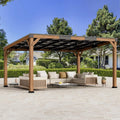
The best type of roof for a pergola is the one that matches your weather and your habits, not the one with the longest feature list. Hot, still climates reward louvered roofs because ventilation and shade control matter more than total rain cover.
Use this decision framework:
- If you host often and want shade control: choose louvered.
- If you need all-weather, set-and-forget cover: choose solid.
- If you face heavy rain and wind: prioritize drainage design and wind ratings.
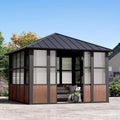
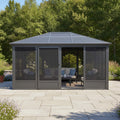
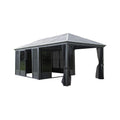
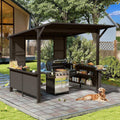
A sloped polycarbonate hardtop, like this wall-mounted gazebo with a sloped roof, suits homeowners who want weather protection with natural light still coming through.
Installation, Permits, and Structural Considerations for Each Roof Style
Installation difficulty separates the two styles more than most buyers expect. Louvered systems carry more moving parts, so assembly and alignment take longer, and motorized units add wiring. Solid roofs are mechanically simpler but heavier, which raises the stakes on anchoring and structural support.
Permits and building codes deserve a call to your local building department before you order anything. Our guide to gazebo assembly time requirements breaks down realistic setup expectations.
Choosing Your Pergola Roof at Backyard Sanctuary Supply
We do not think there is one right roof for every yard.
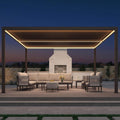
Backyard Sanctuary Supply stocks louvered pergolas with adjustable louvers, integrated drainage, and remote-controlled LED lighting, alongside hardtop gazebos built for uninterrupted shade and year-round use.
The real challenge is not picking a roof style. It is finding structures that hold up through brutal summers, monsoon rains, and everything between without constant repair.
Frequently Asked Questions
Are louvered pergolas worth it?
They are worth it if you want control over sun, shade, and airflow without giving up rain protection. A louvered pergola lets you open the slats for full sun, angle them for partial shade, or close them completely so the hidden gutter system channels water through the posts. That flexibility suits homeowners who use the patio year-round and host gatherings in changing weather. The trade-off is a higher upfront cost than a fixed roof, so weigh how much adjustable comfort matters to your daily use.
Do louvered pergolas leak when it rains?
A well-built louvered pergola with interlocking slats and integrated drainage is designed to shed rain without dripping on the seating area. When the louvers are fully closed, water flows into a hidden gutter and down through the posts. Leaks typically appear when slats are left partially open during heavy rain or when debris clogs the drainage channels. Regular cleaning of the gutters and closing the louvers before a storm keeps the space dry.
Is a louvered pergola more expensive than a solid roof?
Yes, generally. Published 2026 cost comparisons list lattice-style louvered coverage at $90 per square foot versus $125 per square foot for a fully covered solid-roof pergola, though those figures do not specify whether installation is included. Other industry sources report that fixed-roof pergolas cost 30% to 50% less than motorized louvered systems. The gap reflects the moving parts, motors, and drainage engineering that louvered roofs require.
Which provides better shade: a louvered pergola or a solid roof?
A solid roof delivers consistent, uninterrupted shade and full overhead rain protection, which suits hot climates where you want dependable cover all day. A louvered pergola gives adjustable shade: close the slats for complete coverage or tilt them for filtered light and airflow. If you want to control sun exposure and keep air moving, louvers win. If you want the same deep shade every hour of the day, a solid roof is the simpler answer.
What is the best type of roof for a pergola in a rainy climate?
In a rainy climate, prioritize a roof with proven water drainage: either a solid roof with a sloped design or a louvered pergola with interlocking slats and a hidden gutter system that routes water through the posts. Solid roofs offer uninterrupted coverage, while louvered roofs let you close the slats before a storm and reopen them afterward for airflow. Both work when installed with proper anchoring and runoff planning, so match the choice to how much adjustability you want.