Can You Level Uneven Patio Pavers for a Gazebo?
Last Updated: October 25, 2026
Quick Summary
You can level uneven patio pavers for a gazebo by fixing the base, not just the surface, since a gazebo is only as stable as the patio beneath it. Lift sunken pavers, add or remove bedding sand, screed it flat, and tap each unit back down. Keep the post bearing points even while the surrounding patio retains a gentle drainage slope.
- Pavers sink because of soil settlement, washed-out bedding sand, poor drainage, tree roots, and heavy foot traffic.
- A paver patio should keep about 1/8 to 1/4 inch of fall per foot for runoff.
- For a dip of about 1/2 inch across one to three pavers, a no-removal adjustment often works.
- If a paver rocks when you step on it, the base is the problem, so lift it and fix the base.
- Many manufacturers specify a concrete foundation or engineered footing for hardtop gazebos.
Table of Contents
- Can You Level Uneven Patio Pavers for a Gazebo?
- Why Patio Pavers Sink and Shift Before a Gazebo Goes Up
- How to Measure Slope and Level Across the Gazebo Footprint
- Tools for Leveling Patio Pavers and What Each One Does
- How to Fix Sunken Pavers and Reset Raised Ones
- Leveling Pavers Without Removing Them: What Works and What Doesn't
- Anchoring a Gazebo to Pavers: Footings, Load, and Drainage
- Choosing a Gazebo That Fits Your Leveled Patio
- Frequently Asked Questions
Can You Level Uneven Patio Pavers for a Gazebo?
Yes, you can level uneven patio pavers for gazebo installation, and it is often the smartest move before a structure goes up. The key is fixing the base, not just the surface.
You are building a foundation that carries real weight and sheds water.
Below, we show you exactly how to level uneven patio pavers and prep them for a gazebo, step by step.
Why Patio Pavers Sink and Shift Before a Gazebo Goes Up
Pavers sink and shift because the ground under them moves: sand washes out, soil settles, and traffic pushes units down. A gazebo adds concentrated weight at its posts, so any soft spot gets worse fast.
The most common causes we see:
- Settlement: Soil compacts over time and leaves voids under the pavers.
- Washed-out bedding sand: Water finds a low spot and carries sand away.
- Poor drainage: A flat patio traps water, and trapped water softens the base.
One thing to know early: a paver patio should keep a slight drainage slope. Mutual Materials paver installation guidance recommends about 1/8 to 1/4 inch of fall per foot for runoff.
How to Measure Slope and Level Across the Gazebo Footprint
Measure slope across the whole gazebo footprint, not one paver. Set a long straightedge or 4-foot level across the area, look for dips and high edges, and mark every low spot with chalk.
Follow these steps:
- Lay a straight 2x4 across the patio and set a spirit level on top.
- Slide a shim under the low end until the bubble centers, then measure the gap. That gap over the board length tells you the fall.
- Check in a grid, front to back and side to side, so you catch every dip.
- Mark sunken and raised pavers with chalk so you can plan the repair.
- Note where the gazebo posts will land. Those spots need the firmest, flattest base.
Watch out: a single high paver can hide a wide low area around it, so check the full footprint.
Measure the way a gazebo actually sits
A gazebo footprint is a rectangle defined by its posts, not the whole patio. Measure that rectangle first, then check the surrounding field for drainage:
- String the post locations. Drive a stake at each post corner and run a string line between them. The string gives you a straight reference for both level and slope across the exact footprint.
- Check each post-to-post span. Set a 4-foot level or a straightedge along each side and each diagonal. Diagonals catch twist that side-to-side checks miss.
- Use a laser level for larger footprints. A rotary or cross-line laser on a tripod lets one person read the whole footprint against a single reference plane. Mark the reference height on each stake, then measure down to the paver surface at each post location.
What tolerance is acceptable
There is no universal number, the gazebo manufacturer's instructions govern. A common pattern is that post contact points must be flat and solid within a small fraction of an inch of each other while the surrounding patio keeps a gentle drainage slope. Use these rules of thumb, then confirm against your manual:
- Post-to-post level: The four post bearing points should sit within roughly 1/8 inch of each other unless the manual says otherwise. A post that sits high or low by more than that will rock or load unevenly.
- Under-foot flatness: Across the gazebo footprint, dips deeper than about 1/4 inch over a 4-foot span are worth fixing before assembly.
- Drainage slope: The patio as a whole should fall about 1/8 to 1/4 inch per foot away from the house and away from the gazebo, so water runs off rather than pooling under the structure.
Separate "level" from "drains"
These goals pull in different directions, and confusing them is the most common measurement mistake. A level gazebo footprint means the post bearing points are even and solid; a draining patio means the surface tilts slightly so water moves away.
If your measurements show the slope running toward the house, or a low spot holding water near a post, fix the drainage before you set the gazebo. Pooling water softens the base and undermines the footings you just leveled.
Tools for Leveling Patio Pavers and What Each One Does
The right tools make this job faster and safer. You do not need a full crew, but you do need the basics:
| Tool | What It Does | When You Need It |
|---|---|---|
| Rubber mallet | Taps pavers into position without cracking them | Resetting every paver |
| Scrap 2x4 board | Spreads force and screeds sand flat | Tamping and leveling sand |
| 4-foot level | Checks flat and slope across the surface | Measuring the whole footprint |
| Putty knife or pry bar | Lifts a single paver cleanly | Fixing one sunken unit |
| Plate compactor | Compacts the base and bedding | Larger repairs |
| Hand tamper | Compacts small areas | Tight spots near posts |
| Broom and joint sand | Refills gaps after resetting | Finishing the job |
A rubber pad between the mallet and paver protects the surface. For small dips, a putty knife and bedding sand may be all you need; for bigger areas, the plate compactor earns its keep.
How to Fix Sunken Pavers and Reset Raised Ones
Fixing sunken pavers means lifting the low unit, adding bedding sand, and tapping it back into position. Raised pavers get the opposite treatment: pull sand out until the paver sits flush.
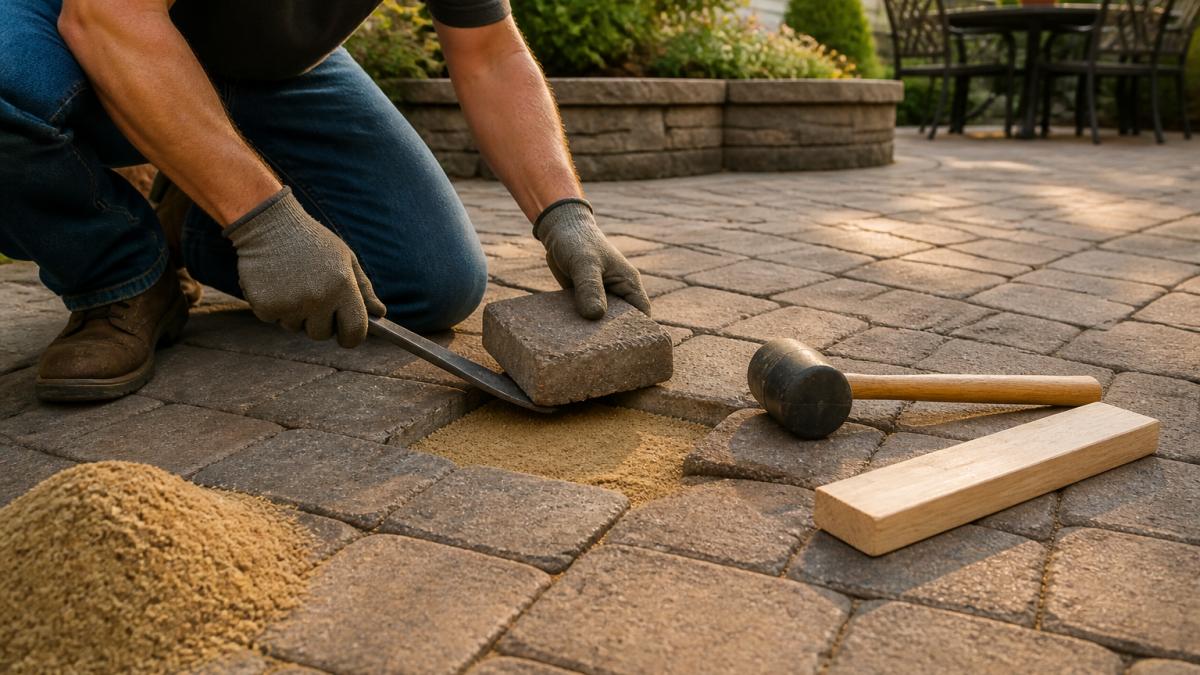
Work through it like this:
- Lift the paver. Slide a putty knife or pry bar under the edge and work it free.
- Check the base. Clear out loose sand and any soft spots underneath.
- Add or remove sand. For a sunken paver, add bedding sand. For a raised one, scoop sand out.
- Screed it flat. Drag a scrap 2x4 across the sand to level it.
- Reset the paver. Set it back in place and tap it down with a rubber mallet over a rubber pad.
- Check with the level. Confirm it matches its neighbors before moving on.
- Refill joints. Sweep joint sand into the gaps and mist it lightly.
For a dip of about 1/2 inch across one to three pavers, a no-removal adjustment often works, according to Kingdom Paver's 2026 repair guide. Bigger dips usually need the paver lifted and the base reset.
Wall-Mounted Patio Gazebo Large Outdoor Hardtop Pergola with Sloped →
Leveling Pavers Without Removing Them: What Works and What Doesn't
Leveling pavers without removing them works for small dips and fails for structural problems. Foam injection can lift a settled slab or paver from below by filling voids, fast and clean, but not a fix for a soft, failing base.
What works without removal:
- Foam injection for minor settlement where the base is still solid.
- Sand top-off for shallow dips you can reach from the joints.
- Tapping down a slightly high paver with a mallet.
What does not work:
- Foam over a washed-out base that keeps moving.
- Sand tricks on a paver that is rocking on a void.
- Skipping compaction, which lets the dip return.
If a paver rocks when you step on it, the base is the problem. Lift it and fix the base. Foam is a shortcut, not a cure.
Anchoring a Gazebo to Pavers: Footings, Load, and Drainage
Anchoring a gazebo to pavers requires more than setting posts on the surface. The gazebo's weight and wind load travel through its posts, so each post needs a firm, stable footing, this is where a leveled patio earns its value.
Gazebo.com's yard prep guidance notes that gazebos without floors should sit on a concrete foundation. That is a strong signal: check your specific model's install requirements before you assume pavers alone will do.
How the load actually reaches the ground
A gazebo does not load the patio evenly. Its weight and any snow or wind load concentrate at the four or more post locations, transferred through small contact patches, often a few square inches per post. That is why a patio that feels flat underfoot can still fail under a post: the paver under the post punches into soft bedding sand while the rest of the field stays put.
Plan for these load paths:
- Post footings: Set each post on compacted, stable ground. Add a concrete footing or anchoring plate if the model calls for it. A common pattern is a concrete pier or a precast footing block set below the paver surface, with the post base bearing on it rather than on the paver alone.
- Load spread: A hardtop gazebo carries snow and wind load. Spread that weight across a firm base, not soft sand. Where the manufacturer allows pavers, a solid concrete paver or a steel base plate under each post spreads the point load.
- Drainage: Keep the patio slope so water runs off. Do not trap water under the gazebo or against a post footing.
Match the anchor to the substrate
| Substrate under the post | Typical anchor | What to verify |
|---|---|---|
| Concrete footing or pier | Expansion screws or wedge anchors | Manufacturer's minimum embedment depth and edge distance |
| Solid paver over compacted base | Expansion screws into the paver, or base plate with stakes | Paver is not cracked or hollow-sounding; base is compacted |
| Paver over bedding sand only | Manufacturer-approved stake or weighted base | Stakes reach firm soil below the sand; model allows surface anchoring |
| Soft or unsettled ground | Concrete footing per manufacturer or engineer | Footing size and depth meet the model's requirements |
When pavers are not enough
Pavers can suit a lightweight gazebo the manufacturer approves for surface mounting, but they are usually not a substitute for a structural footing when:
- The manual calls for a concrete foundation, pier, or engineered footing.
- The gazebo is a permanent hardtop model with significant snow or wind load.
- The patio base is thin, unsettled, or drains poorly.
In those cases, install the footing the manufacturer or a qualified installer specifies, then bring the paver surface flush to it. Leveling the pavers is still worthwhile, it gives you a clean, stable surface around the footings and keeps water moving away.
Before you anchor, it helps to know how long assembly takes. Our guide to modern gazebo assembly time requirements breaks down what to expect.
Choosing a Gazebo That Fits Your Leveled Patio
Choosing a gazebo starts with footprint and anchoring needs, not looks. Once the patio is flat and stable, match the structure to the space and the way its posts will sit.
A few picks from our collection that suit a leveled paver patio:
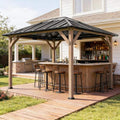
- The Alora Luxury Modern Cedar Gazebo With Sloped Hardtop Roof pairs natural cedar with a galvanized steel hardtop and a sloped roof for runoff. It ships free within the continental U.S.
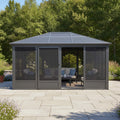
- The Alora Premium Outdoor Double-Layer Galvanized Steel Hardtop Gazebo Pergola offers a large 12x20 footprint with pre-drilled aluminum poles built for secure anchoring.
- The Wall-Mounted Patio Gazebo with Sloped Polycarbonate Roof anchors to soft or hard ground with stakes or expansion screws, a good fit for a patio against the house.
Browse the full gazebos collection to compare footprints and roof styles.


Frequently Asked Questions
Can you install a gazebo on uneven patio pavers?
Not safely. A gazebo needs its support points on a stable, level surface, and uneven pavers create both a rocking structure and a trip hazard. Gazebo.com advises that gazebos without floors should sit on a concrete foundation, so check your model's own installation instructions first. If the pavers are only slightly out of level, resetting and re-screeding the affected area can bring them within tolerance. If the whole patio has settled, address the base before the gazebo goes up.
How flat does a patio need to be for a gazebo?
Flat is not the same as level. Your patio still needs a drainage slope, and Mutual Materials recommends a 1/8- to 1/4-inch-per-foot slope so water runs off. What you cannot have is a dip or hump under a post. Measure across the gazebo footprint with a 4-foot level and a straightedge; any gap under the straightedge marks a low spot that needs correcting before you anchor anything.
What tools do you need for leveling patio pavers?
The core kit is a 4-foot level, a straightedge or scrap 2x4, a rubber mallet, a rubber pad, a putty knife or pry bar, a screed board, bedding sand, and polymeric joint sand. For larger repairs, add a plate compactor. For spot fixes on a few pavers, Kingdom Paver's 2026 guidance describes no-removal adjustment for dips of about 1/2 inch across one to three pavers, which needs only a mallet and sand.
How do you anchor a gazebo to patio pavers?
Anchoring to pavers alone is rarely enough. Most manufacturers require the posts to reach a footing, either expansion screws into a concrete slab or stakes driven into soil. The wall-mounted gazebo in our collection can be mounted to your home's exterior wall with included hardware or anchored to soft or hard ground with stakes or expansion screws. For a freestanding hardtop gazebo, set concrete footings at each post location and let them cure before assembly.
Leveling a paver patio for a gazebo is real work, but it protects your investment. A flat, well-drained base keeps posts solid and stops water damage before it starts. Backyard Sanctuary Supply LLC carries weather-resistant gazebos built for year-round use, with free shipping on most orders within the continental U.S. Get started with Backyard Sanctuary Supply LLC and give your gazebo the foundation it deserves.