How to Choose the Perfect Outdoor Patio Heater: 2026 Guide
Quick Summary
Choose an outdoor patio heater by measuring the seating zone and counting open sides before comparing models. Match the output rating to that zone, then pick a fuel type based on power access and tank storage. Confirm clearance distances and wind performance before you buy.
- Measure the usable seating area, not the whole patio, since open sides lose warmth quickly.
- Convert electric wattage to BTUs by multiplying by about 3.41, since one watt is roughly 3.41 BTUs per hour.
- Choose propane for yards far from power, and electric for enclosed covered areas with a dedicated circuit.
- Position the heater on the windward side of the seating area, because wind strips warmth within seconds.
- Never run a propane heater inside a garage, enclosed porch or tent, because carbon monoxide builds up quickly.
Table of Contents
- Start With Your Patio Size and Layout
- Matching Heater Output to Your Patio: Understanding Patio Heater BTU
- Propane vs. Electric Patio Heater: Choosing the Right Fuel Type
- Heater Styles and Placement: Freestanding, Tabletop, Wall-Mounted, and Hanging
- Weather Resistance, Wind, and Running Costs: Real-World Performance
- Best Outdoor Heaters for a Covered Patio and Safety Clearance Rules
- Selecting Your Outdoor Heater Before Your Next Gathering
- Frequently Asked Questions
Start With Your Patio Size and Layout
Choosing an outdoor patio heater starts with measuring the space, not browsing models. A heater that works on a 100-square-foot balcony will leave a 400-square-foot deck cold. Measure the usable area where people will actually sit, then note how many sides are open. Open sides let warmth escape quickly.
Size the heater for the seating zone, not the whole yard. Map the chairs, the table and the walkway. Then decide whether the heater needs to cover one lounge group or the entire patio.
Layout matters as much as square footage. A covered patio traps heat and reflects it back down, while an open deck loses it to the air. Ceiling height and overhangs also affect where heat collects. Sketch the space on paper before you shop.
Watch out: Measuring only the floor area misses the open sides. A three-sided pergola needs more output than a four-walled sunroom of the same size.
Matching Heater Output to Your Patio: Understanding Patio Heater BTU
Output is measured in BTUs for gas heaters and in watts for electric ones. A British thermal unit (BTU) is the amount of heat needed to raise one pound of water by one degree Fahrenheit (Glossary). Electric models are rated in watts.
Higher output does not always mean better results. An oversized heater can overheat a small seating area and waste fuel. An undersized one leaves guests shivering at the edges. Match the rating to the seating zone and the number of open sides.
| Seating Area | Open Sides | Typical Output Range | Heater Type |
|---|---|---|---|
| Under 100 sq ft | 1-2 | Lower output range | Tabletop or small freestanding |
| 100-250 sq ft | 2-3 | Mid output range | Freestanding tower |
| Over 250 sq ft | 3-4 | Higher output range | Multiple units or high-output tower |
Manufacturers publish coverage claims, so check them against the seating zone you mapped. Treat them as starting points, not guarantees, since wind and temperature change the result.
A Practical Sizing Method You Can Run Before You Shop
Most guides stop at a BTU range. A more reliable approach is to estimate the heat load for your actual seating zone, then add margin for wind and exposure. You do not need an engineering degree to do this; a simple worksheet gets you close enough to compare models.
Start with the temperature rise you want. If the evening is 50°F and you want the seating area to feel like 65°F, your target rise is 15°F. Next, estimate the volume of the zone you are trying to warm, not the whole patio. Multiply the seating area in square feet by an effective ceiling height of about 8 feet for a typical patio cover, or 10 feet for an open pergola. A 120-square-foot seating zone under a cover is roughly 960 cubic feet.
Electric heaters use a different unit. One watt equals about 3.41 BTUs per hour, so a 1,500-watt electric heater delivers roughly 5,100 BTUs. That is enough for a small tabletop zone or a tightly enclosed seating nook, but it will not carry a large open deck. If your worksheet calls for 20,000 BTUs, you are looking at roughly four 1,500-watt electric units, or one mid-range propane tower.
Use the worksheet as a filter, not a guarantee. Radiant heat warms people and surfaces rather than the air, so a heater rated for a smaller area can feel effective if it is aimed directly at the seating zone. Conversely, a high-BTU unit mounted high and far away can underperform a smaller unit placed close to the chairs.
Watch out: Do not size to the square footage of the entire patio. A 400-square-foot deck with a 100-square-foot conversation circle needs output for the circle, plus margin for the open sides around it, not for the full deck.
Propane vs. Electric Patio Heater: Choosing the Right Fuel Type
Propane heaters are portable and generate strong heat without a power outlet. They suit yards far from electrical service. The tradeoff is refilling or swapping tanks, and carrying the fuel safely. Gas heaters also produce more heat per unit than most electric models.
Electric heaters install quickly, need no fuel storage, and produce no combustion byproducts. They are easier to use in enclosed covered areas, provided the space meets local code. The downside is that they need a dedicated circuit and often deliver less heat per dollar of output.
Natural gas is a third option for homes with a gas line already running to the patio. It avoids tank refills but requires professional installation.
Watch out: Never run a propane heater inside a garage, enclosed porch or tent. Carbon monoxide builds up quickly in closed spaces.
Heater Styles and Placement: Freestanding, Tabletop, Wall-Mounted, and Hanging
Freestanding tower heaters are the most common style. They offer the most heat and move easily across the patio. Tabletop units suit small dining spots and sit on the table surface, which limits their output. Wall-mounted and hanging models save floor space but need solid mounting points and careful clearance planning.
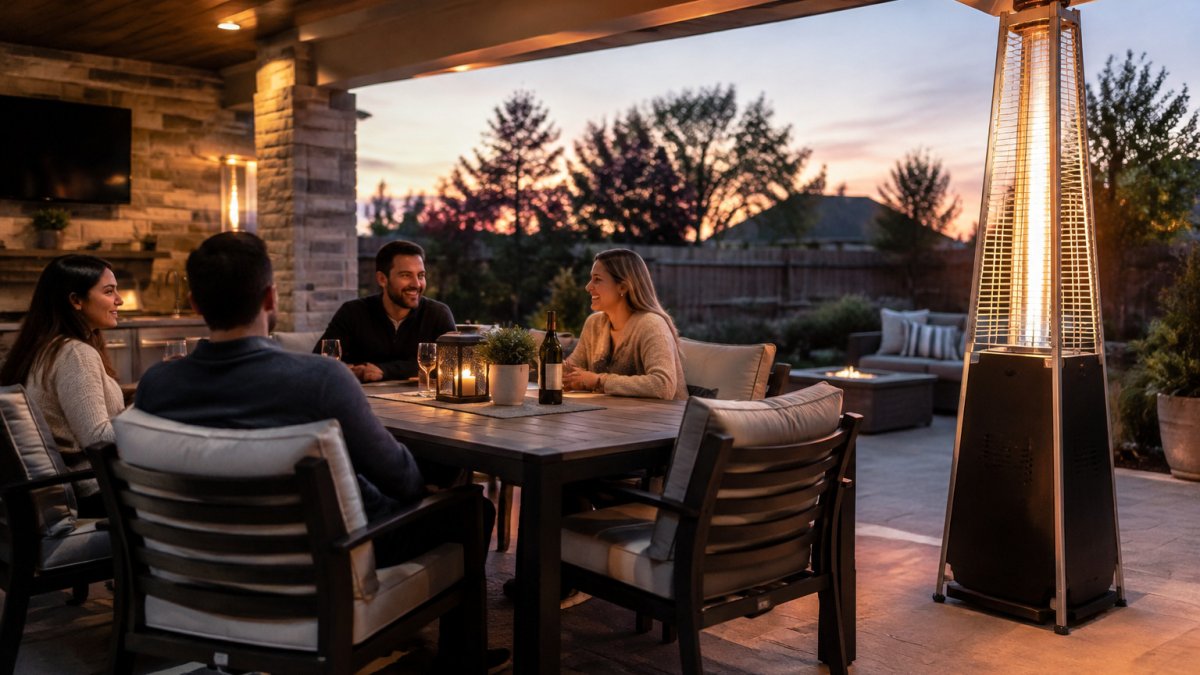
Placement drives performance. Position the heater where it warms the seating zone without blocking walkways. Keep it away from overhead structures that could catch heat, and check the manufacturer's clearance distances before mounting.
Weather Resistance, Wind, and Running Costs: Real-World Performance
Wind is the main enemy of outdoor heat. A breeze can strip warmth from the seating area within seconds. Position heaters on the windward side of the seating area where possible.
Running costs vary with fuel and hours of use. Propane units burn through tanks quickly at high output, while electric units draw steady wattage that shows up on the monthly bill. Compare the cost per hour of use for your local fuel prices before deciding.
Weather exposure also affects longevity. Store the heater or cover it during long off-seasons.
How Wind and Cold Change Real Coverage
Radiant heaters warm people and objects directly, while convective heaters warm the air. That distinction matters in wind. A radiant propane or electric heater can still feel warm on the side facing the element even when the air is moving, but the moment a gust pushes between the heater and the guest, the perceived warmth drops sharply. Convective units that rely on warming the air lose effectiveness faster in open, breezy spaces because the warmed air is replaced before it reaches the seating zone.
A common pattern is that manufacturers rate coverage for still air. That is why placement on the windward side, a windscreen, or a low wall behind the seating area often does more for comfort than adding BTUs. Cold conditions compound the effect: the larger the gap between ambient temperature and your target comfort level, the more output you need, and the more wind matters.
Total Cost of Ownership by Fuel Type
Upfront price is only part of the story. A fair comparison adds fuel or electricity, installation, maintenance, and expected service life. The table below shows the categories to compare; fill in current local prices because they change by season and region.
| Cost Category | Propane | Natural Gas | Electric |
|---|---|---|---|
| Purchase price | Low to mid | Mid to high | Low to mid |
| Installation | None beyond assembly | Professional gas line and permit | Outdoor outlet or dedicated circuit |
| Fuel or electricity | Tank refills or exchanges | Metered gas | Metered electricity |
| Maintenance | Tank inspection, element cleaning | Annual professional check | Element and cord inspection |
| Expected service life | 5 to 10 years with care | 10 years or more with service | 5 to 10 years |
To estimate hourly fuel cost, use the heater's rated input and your local price. At a typical exchange or refill price, that gives you a cost per hour you can compare against a 1,500-watt electric heater, which uses 1.5 kilowatt-hours per hour at full power. Multiply by your electricity rate to get its hourly cost. Natural gas is usually the lowest cost per delivered BTU where a line already exists, but the connection and permit can dominate the first-year cost.
A common pattern is that the lowest purchase price is rarely the lowest total cost over five years. A cheap propane tower with frequent tank exchanges can cost more to run than a mid-priced electric unit on a covered patio, while a natural gas unit with a professional line install can win over a decade if you use the patio often. Run the math for your expected hours per week and your local prices before you decide.
Watch out: Do not compare a propane heater's BTU rating directly to an electric heater's wattage without converting. One watt equals about 3.41 BTUs per hour, so a 1,500-watt electric heater is roughly 5,100 BTUs, not 1,500 BTUs.
Best Outdoor Heaters for a Covered Patio and Safety Clearance Rules
Covered patios trap heat, which makes them efficient but raises fire risk. Manufacturers specify minimum clearances from walls, ceilings and overhangs. Follow those numbers exactly, and check your local fire code. Many areas require a heater to stand a set distance from combustible materials.
For covered spaces, electric and lower-output propane units are often the safer choice. Place the heater with clear overhead space and keep it away from curtains, furniture and string lights. Tip-over protection and automatic shutoff are essential features.
Best for: Covered patios with good ventilation and a dedicated seating zone. Skip if: Your covered area is enclosed with no airflow.
Selecting Your Outdoor Heater Before Your Next Gathering
Work through the decision in order. Measure the seating zone, count the open sides, and set a target output. Choose a fuel type based on power access and fuel storage. Pick a style that fits your layout, then confirm clearance and wind performance.
Before you buy, test the placement with your own furniture arrangement. Shop for a heater that fits the patio you actually have, and check Backyard Sanctuary Supply LLC's website for current pricing or a quote, since prices depend on model, quantity and delivery.
Frequently Asked Questions
What is the most effective outdoor patio heater?
The most effective outdoor patio heater depends on your setup rather than one universal model. The right heater depends on your patio's size, layout and available power access. Match the heater's output and coverage to your patio size, account for wind exposure, and confirm the model meets the clearance requirements in its manual before purchasing.
What is a good BTU for an outdoor patio heater?
A suitable BTU rating depends on the seating zone and how exposed the patio is. Higher output is useful on open, windy patios, but a covered patio often needs less. Check the manufacturer's coverage guidance and adjust for open sides and the temperature rise you want, since wind and open space reduce effective warmth.
Can you use a patio heater under a covered patio?
Yes, you can use many patio heaters under a covered patio, but the ceiling and surrounding materials must provide the clearance specified in the manufacturer's instructions. Gas and infrared heaters have minimum distances from overhead structures, walls, and combustible materials. A covered patio also traps heat, so you may need less output than an open patio. Ensure adequate ventilation, especially with propane or natural gas units, and never place a heater where it could be knocked over or blocked.
How far should patio furniture be from a patio heater?
Keep patio furniture and cushions at a safe distance from the heater, following the clearance distances listed in the owner's manual. Many manufacturers recommend several feet of clearance from combustible materials, though exact figures vary by model. Position tables and chairs where guests can sit comfortably in the heater's warmth without leaning into the heating element. Avoid placing fabric umbrellas, string lights, or dry foliage in the heater's path.