Best Outdoor Kitchen Materials for Hot Climates
Table of Contents
- Why Hot Climates Demand Different Outdoor Kitchen Materials
- Heat-Resistant Outdoor Countertop Materials Compared
- Outdoor Kitchen Cabinet Materials for Sun Exposure
- How to Keep Your Outdoor Kitchen Cool in Summer
- Cost-to-Longevity: Which Outdoor Kitchen Materials Are Worth the Investment
- Sustainable and Eco-Friendly Options for Hot-Climate Builds
- Ready-Built Outdoor Kitchen Islands That Get It Right
- Conclusion
Choosing the wrong outdoor kitchen materials for hot climates is expensive. Surfaces crack, cabinets warp, countertops fade, and what looked premium at installation becomes a maintenance headache within two seasons. Material decisions determine success or failure before a single meal is cooked.
Hot-climate builds face stressors that standard outdoor guides ignore: UV degradation, extreme surface temperatures, thermal expansion cycles, and the brutal combination of dry heat followed by monsoon moisture. Below, we break down every major material category, what actually works in high-heat environments, and where common choices fall short.
Why Hot Climates Demand Different Outdoor Kitchen Materials
Standard outdoor materials are tested for general weather resistance. Hot climates test something more specific: the ability to survive daily thermal cycling, sustained UV bombardment, and surface temperatures exceeding 150°F on dark stone in direct sun.
Thermal Expansion and Structural Integrity
Thermal expansion is the dimensional change a material undergoes as it heats and cools. Every material expands when hot and contracts when cold. In outdoor kitchens, this cycle repeats daily with extreme temperature swings.
Concrete countertops with inadequate control joints crack. Tile grout lines fail. Large-format porcelain slabs installed without proper expansion gaps lift at the edges. According to guidance from the Portland Cement Association on thermal movement in concrete structures, concrete expands approximately 0.000006 inches per inch per degree Fahrenheit, a number that sounds small until you're working with a 10-foot countertop run through a 70°F daily temperature swing. The fix is always the same: choose materials with low thermal expansion coefficients and ensure your installer follows outdoor-rated installation standards with proper substrate preparation and expansion allowances.
UV Degradation, Fading, and Surface Temperature
UV degradation slowly destroys a material's molecular structure, showing up as fading, chalking, brittleness, and surface breakdown. Dark-colored surfaces absorb more heat, compounding the problem. A black granite countertop can reach dangerous surface temperatures on a 95°F afternoon (peer-reviewed research). Polymer cabinet doors that aren't UV-stable yellow and crack within a few years. Powder-coated aluminum holds up well; standard painted steel does not. Look for UV-stable or outdoor-rated designations. Materials without them are being used outside their design parameters.
Heat-Resistant Outdoor Countertop Materials Compared
Heat-resistant countertop materials fall into four practical categories: natural stone, sintered stone, engineered quartz, and concrete. Each handles heat differently, and the right choice depends on your climate's specific combination of sun intensity, humidity, and temperature range.
The best countertop material for a hot, dry climate is granite or sintered stone. Both are genuinely heat-resistant, UV-stable, and non-porous enough to resist staining without aggressive sealing schedules.
| Material | Heat Resistance | UV Stability | Sealing Required | Thermal Expansion | Best For |
|---|---|---|---|---|---|
| Granite | Excellent | Good | Every 1-2 years | Low | Dry heat, full sun |
| Sintered Stone / Porcelain Slab | Excellent | Excellent | None | Very low | All hot climates |
| Engineered Quartz | Moderate | Poor | None | Moderate | Covered/shaded areas only |
| Concrete | Good | Moderate | Every 1-2 years | Moderate | Dry climates with proper sealing |
Granite: Natural Stone With High Heat Tolerance
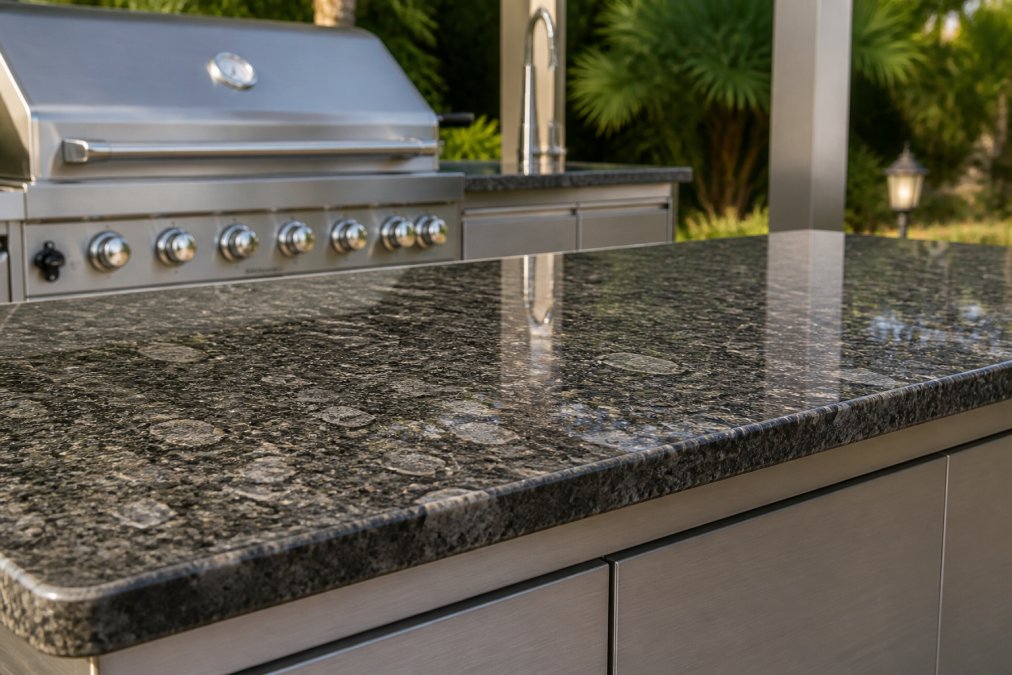
Granite is one of the most heat-resistant countertop options available. It's a natural igneous rock formed under extreme heat and pressure, so a hot pan or 100°F afternoon doesn't threaten its structural integrity. Granite has a low thermal expansion rate, handles direct sun without warping, and its crystalline structure resists thermal shock far better than engineered alternatives. Lighter-colored granite varieties also absorb less heat, keeping surface temperatures more manageable.
The honest limitation: granite is porous. Without sealing every one to two years, moisture and grease penetrate the surface and stain.
Porcelain Slabs and Sintered Stone: Ultra-Compact and UV-Stable
Porcelain slabs and sintered stone products are the strongest performers in hot-climate outdoor kitchens. These materials are manufactured at extremely high temperatures and pressures, producing a non-porous, UV-stable surface with near-zero water absorption. The thermal expansion rate is very low, and the UV-stable surface doesn't fade, chalk, or degrade under sustained sun exposure. Unlike natural stone, there's no sealing requirement, the surface is essentially maintenance-free. The main trade-off is cost: large-format sintered stone slabs run higher than granite, and they require skilled installation to avoid cracking during cutting and fitting.
Quartz: Non-Porous but Sensitive to Direct Sun
Quartz countertops are non-porous and require no sealing, which makes them appealing for outdoor kitchens. The problem in hot climates is the resin binder holding quartz aggregate together. That resin is not UV-stable. Direct sun exposure causes the resin to break down over time, leading to discoloration, surface warping, and in severe cases, delamination. Quartz works in covered outdoor kitchens with significant shade. For open-air builds in sun-belt states, choose granite or sintered stone instead.
Concrete: Durable in Dry Heat With Proper Sealing
Concrete countertops offer design flexibility and handle dry heat reasonably well when properly sealed and reinforced. The structural concern in hot climates is thermal expansion combined with moisture cycling. Control joints and a high-quality penetrating sealer are non-negotiable for outdoor concrete. Without them, cracking is likely within a few seasons. With proper installation, concrete is a durable, cost-effective option that develops character over time.
Outdoor Kitchen Cabinet Materials for Sun Exposure
The biggest mistake in outdoor kitchen cabinet selection is treating sun exposure as a secondary concern. Cabinetry takes more UV punishment than countertops because vertical surfaces face the sun at changing angles throughout the day, and dark colors absorb heat that accelerates material breakdown.

Marine-Grade Stainless Steel: The Industry Standard
Marine-grade stainless steel (specifically 304-grade) is the industry standard for outdoor kitchen cabinetry in hot climates (astm.org). The designation refers to the alloy's corrosion resistance in salt-air and high-humidity environments, which also makes it the right choice for outdoor kitchens facing heat, moisture, and cleaning chemicals. 304 stainless steel is corrosion-resistant, UV-stable, and handles thermal expansion without structural compromise.
High-Density Polymer and Aluminum: Lightweight, Corrosion-Resistant Options
High-density polymer (HDPE) cabinetry offers a maintenance-free alternative to stainless steel in hot climates. HDPE is non-porous, UV-stable in quality formulations, and completely impervious to moisture. It won't rust, rot, or require painting.
Powder-coated aluminum is the other strong contender. It's lightweight, corrosion-resistant, and when applied correctly, UV-stable enough for hot-climate applications. Coating quality matters enormously. Thin or poorly applied powder coating chips and fades; a properly applied, outdoor-rated finish holds up for many years.
Stucco and Concrete Block: Permanent Frames That Handle Extreme Heat
For permanent outdoor kitchen builds, a concrete block or CMU frame finished with stucco is one of the most heat-tolerant structural options available. Masonry has essentially no thermal expansion concern at residential scale, and it provides a moisture barrier when properly sealed and finished. Stucco finishes are UV-stable, paintable, and can be matched to existing architecture. The limitation is permanence: a masonry frame can't be reconfigured once built.
How to Keep Your Outdoor Kitchen Cool in Summer
Keeping your outdoor kitchen functional during peak summer heat is partly a material decision and partly a design decision.
Start with orientation. A kitchen positioned to face north or east avoids the worst afternoon sun in most of the continental United States. West-facing kitchens receive direct sun during the hottest hours, driving up surface temperatures and making cooking uncomfortable.
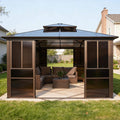
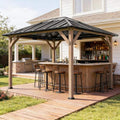
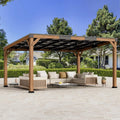
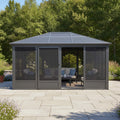
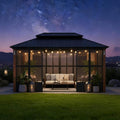
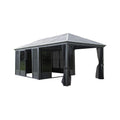
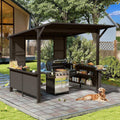
Shade structures matter more than most guides acknowledge. A pergola or hardtop gazebo over your outdoor kitchen reduces surface temperatures dramatically by blocking direct solar radiation. The Alora Premium Outdoor Hardtop Grill Gazebo (available in 13x6 and 9x10 configurations from Backyard Sanctuary Supply) uses a durable metal pent roof that shields the cooking area from both direct sun and sudden rain, the single most effective intervention for hot-climate outdoor kitchen comfort.
Beyond structure, these practices help:
- Choose lighter-colored countertop materials that reflect rather than absorb heat
- Install a ceiling fan in covered kitchen areas to move air
- Use heat-reflective substrate materials under countertop installations
- Orient the grill so prevailing winds carry heat away from the prep area
- Install retractable shade sails for flexible sun control during afternoon hours
Cost-to-Longevity: Which Outdoor Kitchen Materials Are Worth the Investment
The right way to evaluate outdoor kitchen materials isn't upfront cost, it's cost per year of service life. A cheap polymer countertop needing replacement in five years costs more over a decade than a granite slab lasting twenty.

| Material | Relative Upfront Cost | Expected Service Life | Maintenance Cost | Best Value Scenario |
|---|---|---|---|---|
| Sintered Stone / Porcelain | High | 20+ years | Very low | Long-term builds, full sun |
| Granite | Moderate-High | 15-25 years | Low (sealing) | Dry climates, classic look |
| 304 Stainless Steel (cabinets) | High | 20+ years | Very low | All hot climates |
| Concrete (sealed) | Moderate | 10-20 years | Moderate | Dry climates, custom design |
| High-Density Polymer | Moderate | 15-20 years | Very low | Coastal, high-humidity areas |
| Powder-Coated Aluminum | Moderate | 10-15 years | Low | Budget-conscious builds |
The real cost of under-specifying materials shows up in replacement labor, not just material costs. Tearing out a failed countertop on a permanent masonry frame is a significant project. Getting material selection right at the start avoids that entirely.
Sustainable and Eco-Friendly Options for Hot-Climate Builds
Several of the most durable hot-climate materials are also among the more environmentally responsible choices. Sintered stone and porcelain slabs are manufactured from natural minerals without resins or synthetic binders, and their long service life means fewer replacement cycles.
For cabinetry, FSC-certified teak is worth noting. Teak's natural oil content makes it one of the few wood species that genuinely resists moisture and UV degradation without chemical treatment. The Portals Dark Outdoor Kitchen from Backyard Sanctuary Supply uses FSC-certified teak accents alongside a dark aluminum frame, delivering both sustainable sourcing and real-world durability.
Recycled aluminum and reclaimed steel are also viable structural options. Their thermal properties are identical to virgin material, and the embodied carbon footprint is significantly lower.
Ready-Built Outdoor Kitchen Islands That Get It Right
Understanding materials is one thing. Finding a ready-built outdoor kitchen that actually applies these principles is another challenge entirely.
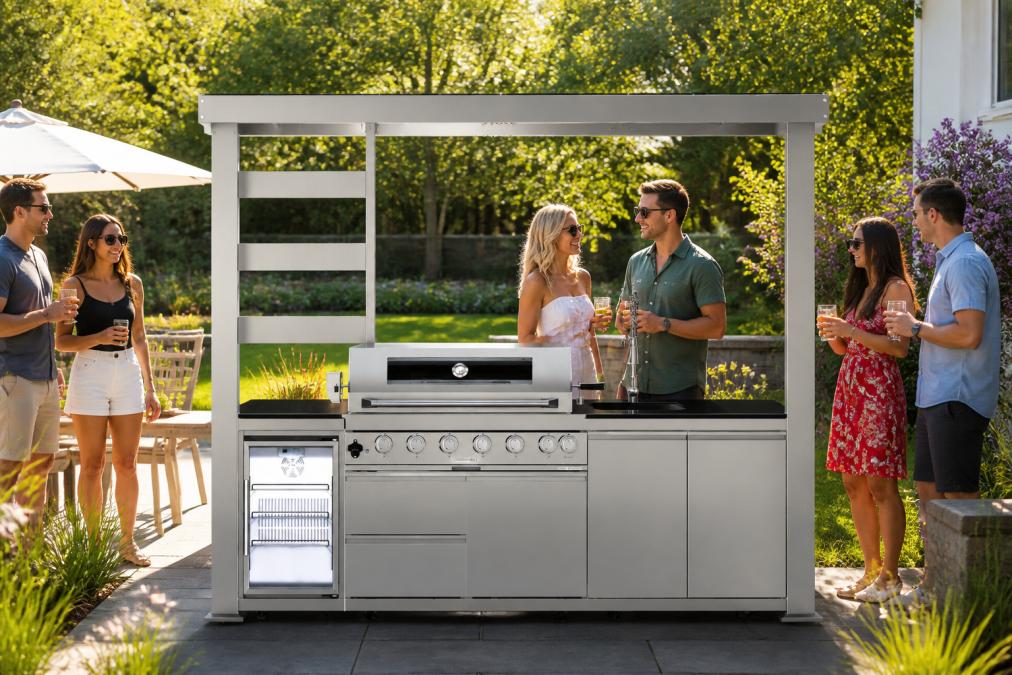
The Castelle Flame series from Backyard Sanctuary Supply represents exactly the material spec that hot-climate outdoor kitchens demand. All three configurations, the Blaze 108-inch ($11,999.97), the Astoria 94-inch ($11,399.97), and the Amalfi 97-inch ($10,999.97), are built from 304 marine-grade stainless steel throughout, with black granite countertops and outdoor-rated refrigeration.

For homeowners wanting a complete outdoor kitchen at a more accessible entry point, the Deluxe 84-inch BBQ Grill Island ($4,181.75) delivers 304 stainless steel construction, Black Galaxy granite countertops, and an integrated sink, the core material spec for a heat-resistant, corrosion-resistant outdoor kitchen without the premium price.
The KoKoMo Outdoor Kitchen BBQ Island with 12' x 12' Pergola ($23,795.00) combines a built-in 4-burner grill and refrigerator with a pergola structure that addresses the single most impactful cooling intervention for hot-climate outdoor kitchens.
What separates well-specified outdoor kitchen islands from underperforming ones comes down to three material decisions: 304-grade (not 430-grade) stainless steel, outdoor-rated countertop material (granite or sintered stone, not standard quartz), and outdoor-rated refrigeration with proper thermal insulation. Every island in the Backyard Sanctuary Supply collection is selected against these criteria.
Hot-climate outdoor kitchens fail at the material level more often than at the design level. The right choices are well-established: sintered stone or granite for countertops, 304 marine-grade stainless steel for cabinetry, and a shade structure to manage surface temperatures. Backyard Sanctuary Supply LLC's outdoor kitchen collection is built around exactly these specifications, 304 stainless steel construction, genuine granite countertops, and outdoor-rated components designed for year-round performance. Explore the Collection at Backyard Sanctuary Supply to find the configuration that fits your space and your climate.
Frequently Asked Questions
Q: What is the best material for outdoor kitchens in high-heat areas?
A: 304 marine-grade stainless steel is a proven choice for frames and cabinetry because it resists corrosion, handles thermal expansion predictably, and does not absorb heat the way wood or polymer composites can. For countertops, granite and sintered stone (porcelain slabs) perform best in direct sun: both are non-porous, UV-stable, and rated for high surface temperatures without warping or cracking. Pair either surface with a shaded overhead structure to reduce peak surface temperature further.
Q: Is granite or quartz better for outdoor kitchens?
A: Granite generally outperforms quartz in direct outdoor sun. Quartz countertops contain resin binders that can discolor, warp, or delaminate under prolonged UV exposure and high surface temperatures, most manufacturers void the warranty for outdoor use. Granite is a natural stone with no resin content, so it handles thermal shock and direct sunlight without fading. Sealed properly once a year, granite stays non-porous and stain-resistant, making it a reliable long-term choice for hot-climate outdoor kitchens.
Q: Does quartz fade or crack in direct sunlight?
A: Yes. Quartz is an engineered stone that binds natural quartz crystals with polymer resins. Those resins are not UV-stable, so prolonged sun exposure can cause the surface to yellow, fade unevenly, or develop hairline cracks from thermal expansion. Most quartz manufacturers explicitly exclude outdoor installations from their warranties. For covered outdoor kitchens with limited direct sun, quartz can work, but in fully exposed hot-climate builds, porcelain slabs or granite are generally more reliable choices.
Q: Why is stainless steel the industry standard for outdoor kitchens?
A: Marine-grade stainless steel (304 or 316 alloy) combines corrosion resistance, abrasion resistance, and structural integrity in a single material. It does not rust when exposed to humidity, rain, or cleaning chemicals. It handles the thermal expansion and contraction that hot climates produce without warping or cracking the substrate. It is also non-porous, so grease and food residue wipe off cleanly. For cabinetry and grill housings, this combination of durability and low maintenance makes it a strong choice.
Q: How do you prevent outdoor kitchen materials from overheating?
A: Shade is a highly effective intervention: a pergola, hardtop gazebo, or shade sail can reduce surface temperature significantly on a hot day. Choose lighter-colored countertops where possible, since dark surfaces absorb significantly more radiant heat. Sintered stone and porcelain slabs have lower thermal conductivity than granite, so they may stay cooler to the touch. Adequate ventilation around the grill island prevents heat from building up inside the cabinet structure, protecting refrigeration units and internal components.
Q: What are the most durable outdoor kitchen cabinet materials?
A: 304 marine-grade stainless steel leads for durability and weather resistance. High-density polymer (HDPE) panels are a strong alternative: they resist moisture, UV fading, and insect damage without sealing requirements. Powder-coated aluminum is lighter than stainless steel and equally corrosion-resistant, making it a good fit for modular builds. Standard wood cabinetry in hot, humid climates may require more maintenance than metal or polymer options.
Q: What are the outdoor kitchen trends for 2026?
A: Current trends center on ultra-compact surfaces like sintered stone for countertops, integrated shade structures built into the kitchen frame, and sustainable material choices such as FSC-certified wood accents paired with recycled aluminum frames. Homeowners in hot climates are increasingly choosing lighter countertop colors to reduce heat absorption, and full outdoor kitchen islands with built-in refrigeration and wine coolers are popular investment pieces.